When my children were younger we began the tradition of attending a Seder dinner at a local church and it brought so much meaning to the tradition of the Jewish Feast and the celebration of our Savior, Jesus!
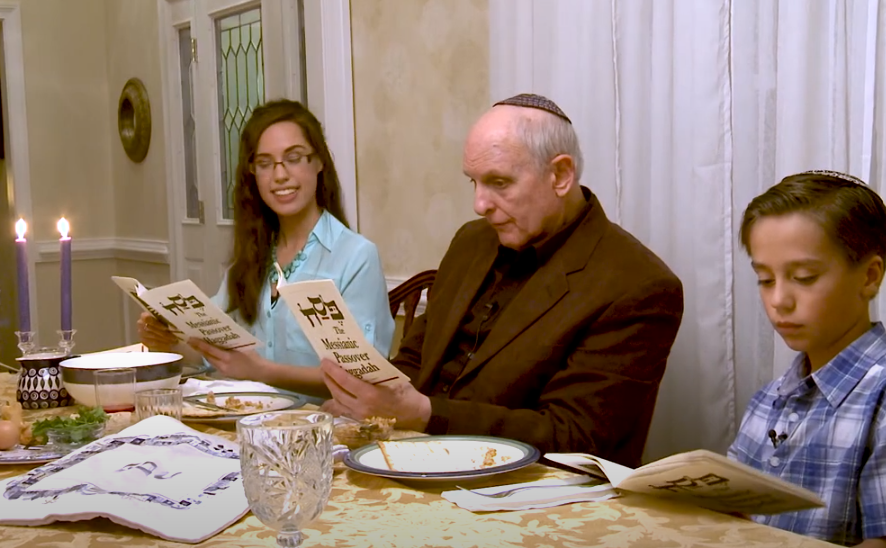
A few years later I discovered an amazing video on YouTube from the creators of Super Book! In the video, 3 young adults share a Seder meal with a Messianic Jewish family. Click here for the video!
This was the inspiration I needed to have our own Seder meal at home! I watched the video and bought each item needed for the meal (lamb shank bone, grape juice, charoset ingredients, parsley, horseradish, eggs, and matzah crackers.)
We set up the computer at the table so we all could see the video and then we would participate with the family while enjoying the clips of the Hebrew Exodus and also the Last Supper of Jesus from the Superbook episodes. If you have young children, I highly recommend doing the food and follow along with the video. (You can buy the Haggadah used in the video here.)
Fast forward to another year, I felt that my children were too old to keep the tradition of the Superbook video so I wanted to find a Haggadah that we could do as a family - but pull in more scripture reading into the dinner. I found some great resources for free from websites like Olive Tree Ministries and Chosen People. (Click the links for their Haggadahs) and I took the free information online to put together in a booklet form (instead of 8.5"x11" file size.)
The tricky thing is how to print it so that you can have the pages work correctly! I have to print the odd pages first and then stack them back into my printer to print the even pages. Another idea is that you could print each page and then cut and staple them together! Each page is numbered so you know which order to keep them in. Download it from this link and save to print for your Passover Seder meal!
I hope it is helpful to you! Also, don't forget a little chocolate coin for the person who finds the afikomen!I almost forgot it this year!!! (I give a little chocolate to everyone! It's a nice little after dinner treat!)
Here was my list for everything we needed: Candle Bowl for water Lamb shanks Eggs (one for each person and more for the meal if you want!) Horseradish (I bought the small jar) Matzah Crackers Parsley Linen napkins to wrap and hide the afikomen (cracer) and to wipe hands during the hand washing. Apples, honey, walnuts, cinnamon, and grape juice for the charoset Chocolate coins 4 cups for each person (and a place setting for Elijah) or you can fill 1 cup as you go through the Haggadah. A small cup of salt water for each person at the table
The Passover meal can be whatever you like to include! We have some matzah ball soup, lamb, potatoes, carrots, pickled vegetables, and more!
Also, the melody for Dayenu can be found here:
This is also a great chart to review while celebrating Passover! Thanks to my friend Lauren who shared it with me! You can read more about each plague here.
Thank you for reading my post! לְשָׁנָה הַבָּאָה בִּירוּשָלָיִם Next year in Jerusalem!
While planning and working on preparations for Year 1 Ambleside , I have found some amazing resources for study guides. Unfortunately, one of the resources is no longer free so I came up with my own document that you are welcome to download and use! CLICK HERE to download the coloring pages I also wanted to have a resource to see the color versions of the birds so I created a photo guide to each bird. CLICK HERE to download the photo companion. Here are some other helpful resources! Burgess Bird Study Guide Burgess Bird Images and more links
Community dancing is such a wonderful activity for all ages! I have seen the question pop up in many homeschool groups about suggestions for resources to teach folk dances so I want to share some of my favorites from teaching music and dance to elementary students in public school and our homeschool groups! If you have the opportunity to find a group already in place to attend and learn dances and observe how they teach you will have a better understanding of how to approach this in a group setting! You may feel like at the beginning like you are herding a bunch of cats but that's ok!!! Practice and consistency will improve the process! Cited Material First, I want to just say how blessed I am that I have been fortunate to have training under the most talented folk dance and movement specialists. I feel like my education and experience has been in the "golden" age through first hand workshops by the following professionals. New ...
In my last post "Part 1 - Tonic Sol-fa and Rhythm" I introduced a little bit of the history behind the music education methods that were used to teach children in the PNEU schools by Charlotte Mason and her teachers. Today I want to address the list of songs and melodic training within the schools. My driving question through some of the research and reading I've done is "HOW were these singing and musical skills taught?" I've come to the conclusion that for young students, the music instruction was given by "rote" or by the training in the sol-fa method that sequenced skills in order to sight sing a written melody. Rote singing is simply aural instruction that can be done by echoing phrases until a student has learned the entire passage, and/or continual exposure to the song until mastery is demonstrated in the ability to sing alone and with others. I think this method was probably most prevalent. I'm learning more about what Miss Ma...




Comments
Post a Comment